Triangles are everywhere. From roof designs to smartphone screens, these three-sided shapes help build our world. But sometimes, triangles can be tricky. What if you know only two sides and one angle? How can you find the rest?
That’s where the law of cosines calculator comes in. It’s a handy online tool that helps you solve triangles fast—no long math formulas or confusing steps. Whether you’re a student, a teacher, or just someone curious about geometry, this guide will help you understand exactly how it works and how to use it with confidence.
1. What Is the Law of Cosines?
The law of cosines is a rule in trigonometry that connects the lengths of a triangle’s sides with one of its angles. It works for any triangle, not just right ones.
The formula looks like this:
c² = a² + b² – 2ab × cos(C)
Here:
- a, b, and c are the sides of the triangle.
- C is the angle opposite side c.
This formula helps when you can’t use the Pythagorean theorem (which only works for right triangles). The law of cosines calculator uses this rule automatically so you can find missing sides or angles with just a few clicks.
2. How Does a Law of Cosines Calculator Work?
A law of cosines calculator is like a super-smart math buddy. You type in what you know—maybe two sides and an angle—and it quickly figures out what’s missing.
Here’s how it works step by step:
- You enter the sides or angles you already have.
- The calculator applies the law of cosines formula.
- It solves for the unknown side or angle instantly.
You don’t need to do any manual math. It’s fast, accurate, and works for every type of triangle—acute, obtuse, or right. This makes it perfect for students checking homework or engineers working on real-world projects.
3. When Should You Use the Law of Cosines?
You use the law of cosines calculator whenever you can’t use simpler trigonometric formulas.
Use it when:
- You know two sides and the included angle (SAS).
- You know all three sides (SSS) and need to find an angle.
For example, if you know two sides of a triangle are 5 cm and 7 cm, and the angle between them is 60°, the calculator can find the third side for you.
It’s especially helpful when solving real-life problems, like finding the distance between two points on a map or figuring out the shape of a roof truss.
4. The Formula Explained Simply
Let’s break down c² = a² + b² – 2ab × cos(C) into easy words.
- Square both known sides (a² and b²).
- Multiply both sides (a × b) and then multiply that result by 2 and by the cosine of the given angle (cos(C)).
- Subtract that number from the sum of the squared sides.
- Finally, take the square root to get the length of the missing side.
Example:
If a = 5, b = 7, and C = 60°,
c² = 5² + 7² – 2×5×7×cos(60°)
= 25 + 49 – 70×0.5
= 74 – 35
= 39
So c = √39 ≈ 6.24.
The law of cosines calculator does all this math instantly for you.
5. Benefits of Using a Law of Cosines Calculator
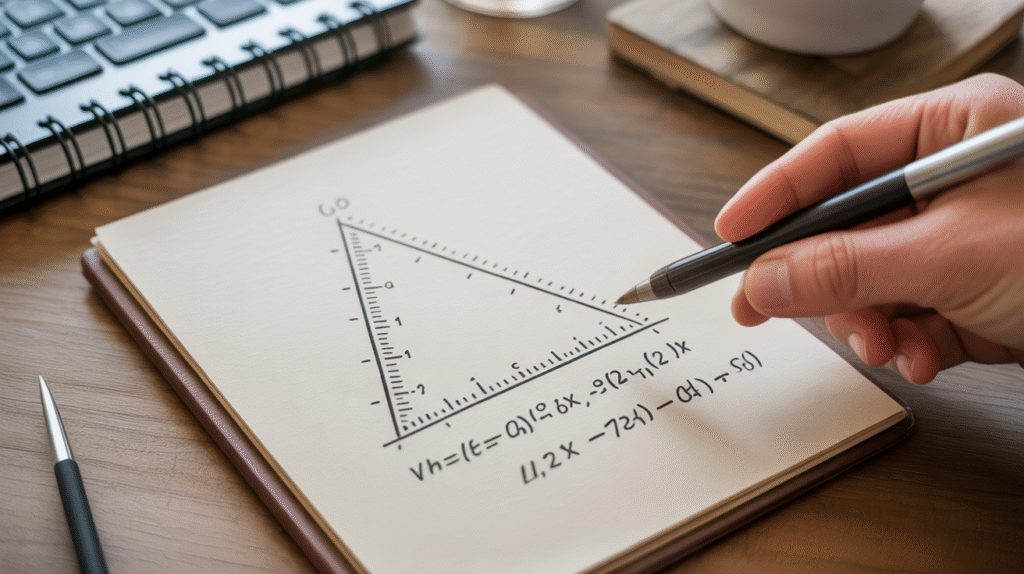
Using a calculator saves time and prevents mistakes. Here are some big benefits:
- Speed: No need to do complex math by hand.
- Accuracy: It gives exact answers every time.
- Simplicity: You only need to type what you know.
- Learning aid: You can check your homework or confirm classwork results.
- Real-world help: Great for construction, navigation, physics, and more.
Even teachers love using these tools to demonstrate triangle problems clearly and quickly.
6. Real-World Examples
Imagine you’re hiking between three mountain peaks forming a triangle. You know the distances between two peaks and the angle between them. You can use a law of cosines calculator to find the third distance—no climbing needed!
Or, say you’re designing a triangular garden. You know two sides and an angle. The calculator helps you figure out the final side so your plants fit perfectly.
These real-life uses show how math helps in everyday design, travel, and measurement.
7. Difference Between the Law of Cosines and Pythagorean Theorem
Many people mix up these two formulas. The Pythagorean theorem works only for right triangles:
a² + b² = c².
But the law of cosines works for all triangles. If the angle is 90°, cos(90°) = 0, so the law of cosines becomes the Pythagorean theorem!
That’s why the law of cosines calculator is more powerful—it can solve any triangle, not just special cases.
8. Using It for Angles
The calculator can also find unknown angles.
You can rearrange the formula to solve for C:
C = cos⁻¹((a² + b² – c²) / (2ab))
This means if you know all three sides, you can find any angle.
For example, if a = 8, b = 6, and c = 7:
C = cos⁻¹((8² + 6² – 7²) / (2×8×6))
= cos⁻¹((64 + 36 – 49) / 96)
= cos⁻¹(51 / 96)
= cos⁻¹(0.53125)
≈ 57.9°.
Your law of cosines calculator handles this without you ever touching a cosine button.
9. Tips for Getting Accurate Results
When using a law of cosines calculator, small mistakes can lead to wrong answers. Here are a few tips:
- Make sure your angle is in the correct unit (degrees or radians).
- Double-check your side labels (a, b, c) match the correct opposite angles.
- Enter values carefully, especially decimals.
- Use consistent units—don’t mix meters with centimeters.
- Always round answers to a reasonable number of decimal places.
Following these steps helps you get clear, correct answers every time.
10. Online Tools vs. Manual Calculation
While the math behind the law of cosines is simple once you learn it, solving it by hand can take time. An online law of cosines calculator speeds things up and reduces stress.
Manual calculation is good practice for learning, but when you’re working on homework, construction plans, or quick checks, calculators make life easier.
Some calculators even draw the triangle for you, showing sides and angles visually. This helps you see the triangle you’re solving, not just the numbers.
11. Common Mistakes and How to Avoid Them
Even with a law of cosines calculator, errors happen. The most common ones include:
- Mixing up which angle goes with which side.
- Forgetting to switch from radians to degrees.
- Entering sides in the wrong order.
- Rounding too early in calculations.
To avoid these, always label your triangle clearly before you start. Take your time when entering numbers. The calculator is only as smart as the information you give it!
12. Why Learning the Law of Cosines Matters
Learning how the law of cosines works helps you understand more than just triangles. It builds logic, problem-solving skills, and confidence in math.
You’ll use this knowledge in geometry, physics, computer graphics, navigation, and even sports design.
Even if you rely on a law of cosines calculator, knowing the concept behind it gives you real-world power and deeper understanding.
13. Related Tools and Calculators
Besides a law of cosines calculator, there are other helpful tools:
- Law of Sines Calculator: Works when you know two angles and one side.
- Triangle Area Calculator: Finds the area of any triangle.
- Right Triangle Calculator: Uses simpler formulas for 90° triangles.
Using these together gives you a full toolbox for solving every kind of triangle.
14. Frequently Asked Questions (FAQs)
1. What does a law of cosines calculator do?
It helps you find missing sides or angles in any triangle by using the law of cosines formula automatically.
2. Can it solve right triangles too?
Yes! When the angle is 90°, the law of cosines becomes the Pythagorean theorem, so it still works perfectly.
3. Do I need to know trigonometry to use it?
Not really. The calculator does all the math for you. You just need to enter the sides or angles you already know.
4. What units should I use?
Use any consistent unit—like inches, centimeters, or meters. Just don’t mix them together.
5. Is the law of cosines the same as the law of sines?
No. The law of cosines connects sides and angles with cosine, while the law of sines uses sine values. Both are useful for different triangle types.
6. Why is the law of cosines important?
It helps solve triangles that can’t be solved using simpler formulas. It’s used in fields like architecture, engineering, and physics every day.
Conclusion: Math Made Simple
The law of cosines calculator is more than just a math tool—it’s a bridge between learning and doing. Whether you’re solving geometry problems, planning a building, or exploring the world, understanding this formula opens doors to endless discoveries.
So next time you face a tricky triangle, don’t panic. Use your knowledge and the law of cosines calculator to find the answer easily. It’s math made friendly, fast, and fun!